
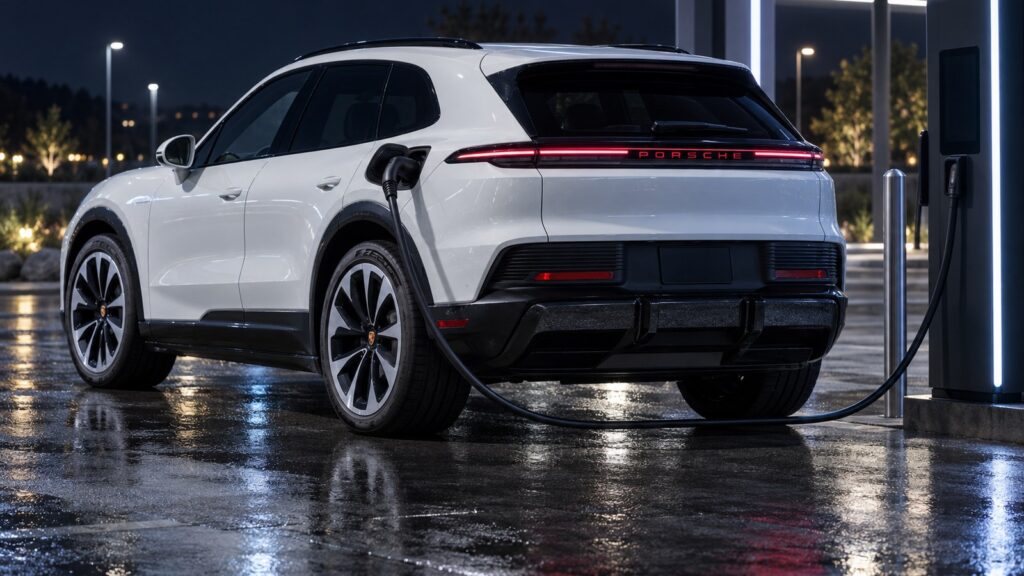
Porsche spent decades proving an SUV could wear the crest. Now the entry-level Cayenne Electric makes a quieter case. It’s quick, gorgeous inside, and refills its battery faster than almost anything on the road. Ask it to play on a twisty road, though, and it would rather head home.
- The base dual-motor Cayenne Electric charged from 5 to 80 percent in 17 minutes and went 326 miles in a 70 mph highway test.
- A curved center screen and smart cabin touches make the interior one of the best in its class.
- Strong brakes and precise steering come paired with a chassis that stubbornly refuses to have fun.
Quick Enough, and Very Smooth About It
The starter Cayenne Electric uses two permanent-magnet motors, one on each axle. With launch control engaged, they make a combined 435 horsepower and 615 lb-ft of torque. Power comes from a 113-kWh battery with 108 kWh usable, running on an 816-volt system.
That’s enough to shove 5,791 pounds of SUV to 60 mph in 4.1 seconds. The quarter mile takes 12.7 seconds at 109.7 mph. The launch feels oddly polite, building in a smooth swell. Passing is easy, with 45 to 65 mph taking just 2.1 seconds.
Rivals are quicker, though. A Lucid Gravity Grand Touring hit 60 in 3.2 seconds, and a quad-motor Rivian R1S needed only 2.6. The Mercedes-Benz EQS580 SUV tied the Porsche to 60 and beat it by a tenth in the quarter mile.
Great Brakes, Polite Chassis
Braking is where this Cayenne shines. On 22-inch Pirelli P Zero summer tires, it stopped from 60 mph in 104 feet and from 100 mph in 296 feet. The Gravity and the R1S both needed 107 feet from 60.
It pulled 0.93 g on the skidpad and lapped the figure-eight course in 24.7 seconds at an average of 0.79 g, beating both the heavier EQS SUV and the Rivian.
Steering is precise, but the car has little personality at the limit. Even in Sport mode with stability control off, it wouldn’t rotate, sliding instead into gentle understeer. For a brand built on driving fun, that’s a strange choice. Porsche could have built a playful chassis and used drive modes to calm it down.
The big staggered tires, 275mm front and 315mm rear, boom loudly over expansion joints, and the Cayenne tramlines over ruts. The 22s are a $2,510 option, so smaller wheels might be worth a look.
Regen braking offers one level plus an automatic mode, with no true one-pedal driving. A synthetic V-8 sound plays over the motor whine, and it’s oddly charming. On the highway, adaptive cruise and lane keeping work so smoothly you forget they’re on.
Range and Charging Steal the Show
The EPA rates the base Cayenne Electric at 317 miles, solid but not class-leading. In a 70 mph road-trip test, it beat that with 326 miles.
Charging is the real headline. The battery accepts up to 400 kW, and the Cayenne went from 5 to 80 percent in just 17 minutes. It added 237 miles of range in the first 15 minutes and 302 in 30. The quad-motor R1S needed 55 minutes for the same charge.
A Cabin Built Around That Screen
The curved center display sweeps from the dash into the console in one smooth arc, and it’s bright, sharp, and quick to respond. A 14.3-inch digital gauge cluster sits ahead of the driver, with Apple CarPlay and Android Auto on board.
Porsche kept physical controls where they matter, including a volume knob and toggles for temperature and fan speed. A sliding console panel hides a wireless charger cooled by the climate system. An optional 14.9-inch passenger screen lets the front passenger stream video while the driver sees a dark panel.
Pick the Trim That Matches How You Drive
The Cayenne Electric starts at $111,350. The test SUV came to $139,440 with options like the $8,320 Premium package, $3,960 leather, and a $3,460 panoramic roof. At that price, quicker and cheaper rivals start looking tempting.
If you want a calm, beautifully built luxury EV that charges fast and brakes like a Porsche, the base model makes a strong case. If you want the sportier feel the badge has long promised, step up to the S Electric or Turbo Electric. The Turbo makes up to 1,139 horsepower.
