
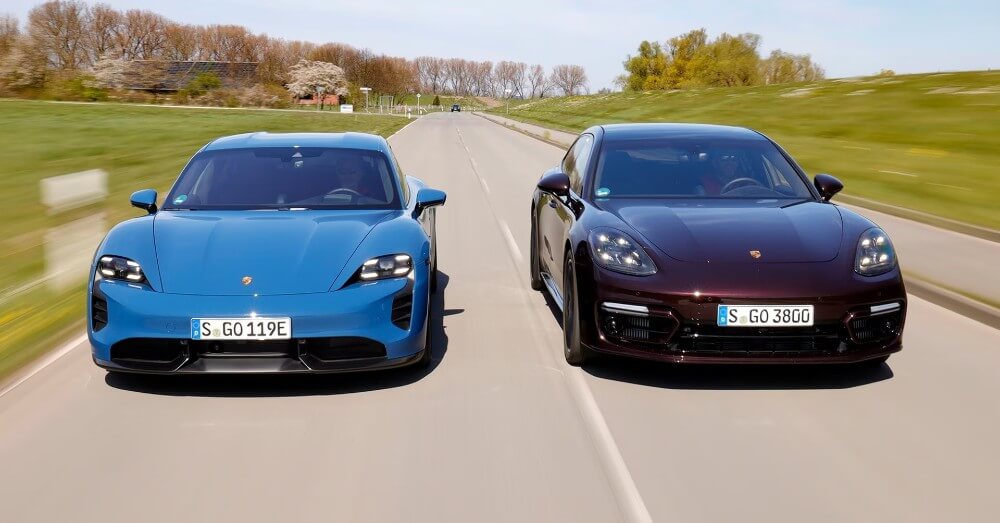
Porsche is quietly redrawing the map of its sedan business, and the result could be one nameplate doing the work of two. Under new CEO Michael Leiters, the company is weighing whether to fold its electric sport sedan and combustion-powered four-door into a single model family with gas, plug-in hybrid, and fully electric options all wearing the same badge.
- A unified sedan line could offer gas, hybrid, and EV powertrains under one name
- Taycan sales fell roughly 60% from their 2021 peak, fueling the rethink
- Replacements likely won’t arrive until after 2030, with two platforms still in play
Why Porsche Is Rethinking Its Sedan Strategy
The idea behind Porsche’s plan to merge the Taycan and Panamera into a single sedan lineup is simple. Stop paying twice for cars that chase overlapping buyers. Porsche is reportedly looking at combining the two nameplates into one unified model line with petrol, plug-in hybrid, and fully electric variants, part of broader cost-cutting moves from Leiters after a downturn in global sales and huge costs tied to the previous CEO’s scaled-back electrification plans.
The financial backdrop is brutal. Porsche’s operating profit dropped 98 percent for the full year, from €5.3 billion in 2024 to just €90 million in 2025, after the company booked €4.7 billion in writedowns tied to its retreat from the original EV roadmap. When you’re bleeding cash like that, running two engineering programs for cars that feel like cousins becomes hard to defend.
Taycan demand tells its own story. Porsche sold just 16,339 Taycans globally in 2025, down from a peak of 41,296 in 2021. That’s a 60 percent slide in four years. The gas Panamera, meanwhile, keeps doing what it has done since 2009, quietly outselling its electric sibling.
How the Merger Could Actually Work
Don’t picture one car bolted together from two parts. A shared sedan line could trim costs while keeping two platforms. In other words, the gas Panamera and an electric successor would still ride on different bones, just under one shared identity and marketing umbrella.
Porsche has already run this playbook. The combustion Macan still sells alongside the electric Macan in several markets, despite the two riding on different platforms, and the same approach has been adopted with the Cayenne. Stretching that template to the executive sedan segment looks like a logical next step.
The platform picture is messy but coming into focus. The third-generation Panamera arrived in late 2023 on Porsche’s MSB architecture, and it’s already penciled in for a mid-cycle refresh around 2027. The Taycan first appeared in 2019 on the EV-dedicated J1 platform and got its facelift in 2024. Whatever replaces today’s cars will almost certainly be offered with gas, hybrid, and fully electric setups, with combustion versions sitting on Porsche’s PPC architecture while EV variants would likely move to the newer SSP Sport platform.
What Happens to the Electric Panamera Successor
If the merger goes through, the next electric flagship sedan probably won’t be called Taycan. Whether the name ends up as a trim level or the Panamera simply absorbs its electric sibling altogether, the bigger story sits higher up the strategy ladder. Porsche wants choice, not one religion.
There’s also good news for combustion fans. Porsche has reassured customers that the Panamera’s gas engines aren’t going anywhere soon, and the V8 Panamera will remain in production well into the 2030s. So even if the badge consolidates, the eight-cylinder party continues.
The two cars are closer cousins than buyers might realize. They’re already very similar in size, with the gas Panamera’s wheelbase measuring 116.1 inches and the Taycan’s just two inches shorter. Smoothing them into one lineup wouldn’t require radical surgery on either side.
Are Buyers Getting a Better Deal?
Mixed bag, honestly. Shoppers walking into a Porsche showroom would see clearer choices and probably more consistent styling cues across powertrains. They’d also benefit from shared parts, which can help long-term service costs.
Current Taycan owners face the tricky part. If Porsche eventually retires the Taycan name in favor of a unified sedan line, owners could face what the industry calls the “orphan model” effect. When a model line disappears or is absorbed into another nameplate, resale values often plummet. Existing Panamera values, by contrast, could hold up better thanks to brand continuity.
Porsche is also clearly trying to avoid another Macan moment. The alternative would be to permanently axe either the Taycan or Panamera, and after the Macan fiasco, that’s a risk not worth taking. Porsche canceled the gas Macan in favor of an EV only to discover that buyers weren’t pleased, forcing development of a new gas crossover that won’t wear the Macan badge.
What to Watch Before 2030
Don’t expect a unified sedan in showrooms tomorrow. Proper replacements for both cars probably won’t arrive until sometime after the end of the decade. That gives Porsche time to settle on a single name, decide how distinct the EV and gas bodies will look, and figure out whether the long-wheelbase China-market variant lives on. For now, if you’ve been eyeing a Taycan, know you may be buying a soon-to-be-collector nameplate. If a Panamera is on the shortlist, you’re probably looking at the name that survives.
