
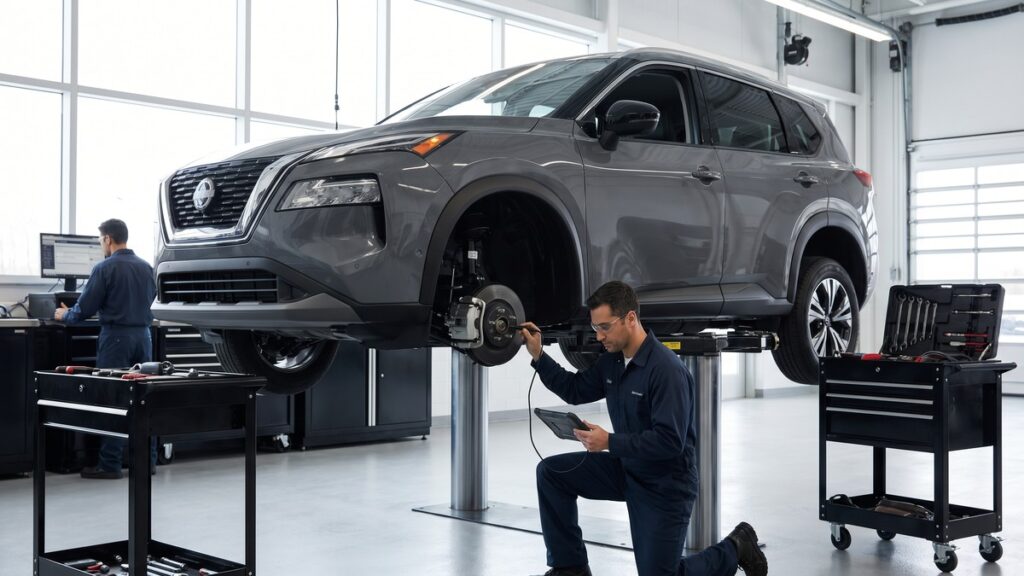
Two fresh Nissan recalls landed this month, and while they cover fewer than 1,000 cars combined, the problems behind them are worth paying attention to. One could let a parked Sentra roll away on its own, and the other can leave a Rogue stuck in neutral without telling the driver what gear it’s in.
- 946 mostly 2025 Sentra sedans are being recalled over a driveshaft that may not be fully seated in the CVT.
- A separate recall covers 42 transaxle assemblies used in 2022 to 2026 Rogue models.
- No crashes or injuries have been tied to either problem so far.
The Sentra Problem Starts With a Loose Driveshaft
The bigger of the two recalls involves 946 Sentra sedans, most of them 2025 models. The trouble comes down to a front left driveshaft that may not be fully seated inside the continuously variable transmission. When that connection isn’t tight, a few things can go wrong. The car can lose drive power, transmission fluid can leak out of the front axle area, and under certain conditions the vehicle can actually move after the driver puts it in park. Readers interested in the broader context can also explore another recent recall case.
That last part is what makes this one stand out. A car that rolls away on its own is a real hazard, even if the odds of it happening are low. Nissan believes only about 3.8% of the recalled Sentras actually have the defect, but every owner still gets checked.
How Nissan Tracked It Down
The company first caught wind of the issue last fall. A customer was driving when a “CVT reduced power” warning popped up on the dash. A dealership took a look and found an abnormal noise coming from the transmission along with a fluid leak near the driver’s side front axle. The source turned out to be the front left of the transmission assembly, where the driveshaft wasn’t properly seated. For authoritative background, the NHTSA recall lookup offers useful context.
A second nearly identical case showed up just four days later, which was enough to kick off a full investigation. Engineers eventually traced the fault back to a supplier tooling error. The end of a bearing had been made slightly too large, and that extra size kept the shaft from seating the way it should. Small manufacturing slip, big potential consequence.
So far Nissan has logged 13 warranty claims, three technical reports, and two consumer affairs cases connected to the defect. No accidents or injuries have been reported. To sort it out, dealers will inspect the front left driveshaft, and if it isn’t fully seated they’ll replace both the driveshaft and the CVT assembly. That’s a heavy repair that can take more than ten hours to finish. Owner notifications are expected to go out early next month.
The Rogue Recall Is Smaller but Just as Strange
The second action is much narrower, covering just 42 transaxle assemblies fitted to 2022 through 2026 Rogue crossovers. Many of these were remanufactured units, and some carry an internal hardware fault that keeps the transmission from reporting which gear it’s in. That failure to communicate puts the affected vehicles out of step with federal motor vehicle safety standards, which is why a recall was needed.
Nissan spotted the problem back in January during a routine quality check on a 2026 Rogue at its plant in Smyrna, Tennessee. The root cause was pinned to an internal hardware failure inside the control valve assembly’s inhibitor switch. That failure can create an electrical break between the transmission and the Automatic Transmission Control Unit.
Here’s how it plays out on the road. If a driver shifts into neutral, the control unit can lose the gear signal, which causes the engine control module to essentially forget where the transmission is. The gear position then disappears from the dash, and the transmission can get stuck in neutral. Nissan has counted 48 technical reports and 106 warranty claims tied to this one. Dealers will check the manufacturing date code on the transmission control valve assembly, and if it comes from a bad batch, they’ll swap the assembly out.
What Owners Should Do Next
If you drive a recent Sentra or a Rogue, the smart move is to watch your mailbox for a recall notice and follow up with a dealer once it arrives. Both repairs are covered at no cost, and catching either issue early beats dealing with a rollaway scare or a car that won’t come out of neutral. You can also plug your VIN into the NHTSA recall lookup to see if your specific vehicle is affected. Neither recall covers a huge number of cars, but the fixes are straightforward once your Nissan is in the shop.
